
Free Payroll Tool
See what your payroll provider really charges
Most providers hide per-run and add-on fees. Audit your real cost per employee in about 30 seconds, free.
Run the Payroll Fee Auditor →Blog · Payroll Management · Accounting / CPA
Why Accounting Firms Outsource Payroll (Hint: They Know What It Costs to Do It Wrong)
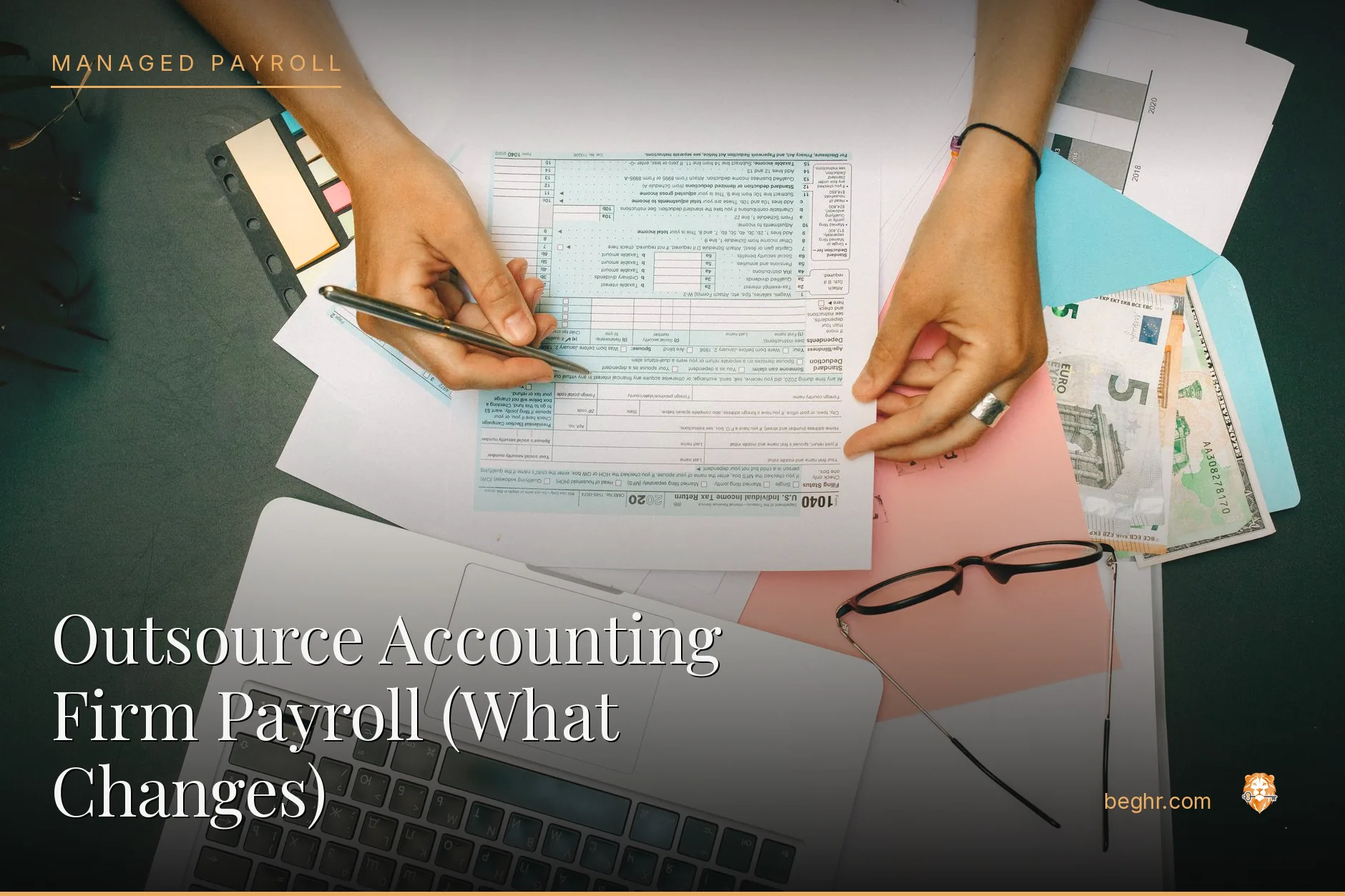
Accounting firms are the professionals clients call when payroll goes wrong. They know exactly what misclassification exposure looks like, what a missed quarterly filing costs in penalties, and what happens when a partner's compensation structure is set up incorrectly for the entity type. Yet many accounting firms manage their own payroll with less rigor than they would recommend to a client - because the shoemaker's children have no shoes. The firms that outsource their own payroll do it for the same reason they tell clients to outsource: the compliance burden is real, the opportunity cost is high, and getting it wrong is expensive in ways that are entirely avoidable.
What Accounting Firms Actually Know About Payroll Risk
CPA firms have a clear-eyed view of payroll risk that most business owners lack. They have seen the client who paid producers on 1099 for five years and received an IRS notice. They have helped clients unwind S-corp salary arrangements that the IRS found unreasonably low. They know what a missed state quarterly return costs in penalties and interest after two years of compounding.
That knowledge makes it particularly ironic when accounting firms carry the same risks internally. The S-corp partner firm where partners take minimal salaries. The multi-state firm with remote staff in four states and no employer registrations in three of them. The firm that applies a comp time policy to non-exempt staff instead of paying overtime.
CPA firms that outsource their own payroll are doing exactly what they tell clients to do: placing compliance responsibility with a specialist who monitors it full-time, rather than managing it as a secondary task in an already-busy operation.
The Opportunity Cost Argument
Accounting firms bill by the hour. Every hour a CPA, manager, or even a skilled administrative professional spends on internal payroll is an hour not spent on billable work. For a firm billing at $150 to $250 per hour, a managing partner who spends 3 hours per month on payroll administration is giving up $450 to $750 in potential revenue per month to manage a function that BEG handles at $25 to $45 per employee per month.
Even at the administrative staff level, internal payroll management carries an opportunity cost. Administrative time spent on payroll entry, reconciliation, and state filings is time not available for client scheduling, office coordination, and other firm support functions. The math for outsourcing payroll is straightforward at almost every firm size past 8 to 10 employees.
The Specific Risks That Push Accounting Firms to Outsource
- Partner compensation structure: LLC vs. S-corp treatment, reasonable compensation standards, and health insurance premium reporting for S-corp partners require technical precision that is easy to get wrong and hard to fix after the fact.
- Busy season overtime: Junior staff and administrative employees who work extended hours during tax season may be non-exempt and entitled to overtime. Firms that do not calculate this correctly carry back-pay liability.
- Remote staff multi-state: Remote hires in new states require employer registrations that must be in place before the first paycheck. Firms that do not act immediately on new remote hires create delinquency exposure in those states.
- Year-end collision: Year-end payroll close collides with the start of tax season. Firms managing their own payroll internally must complete W-2 production and year-end filings at exactly the moment their staff is under the most client pressure.
- 401(k) compliance: Deferral remittance timing, nondiscrimination testing data, and Form 5500 coordination all require payroll records that are complete and accurate before the plan administrator needs them.
What BEG Handles for CPA and Accounting Firms
- Partner W-2 payroll for S-corp and PC partner-employees with correct health insurance treatment
- Non-partner staff payroll including FLSA classification review
- Busy season overtime calculation for non-exempt staff
- Multi-state employer registration and quarterly filings for remote employees
- 401(k) deferral deductions, remittance coordination, and plan administrator data
- Year-end W-2 production and SSA filing by January 31
- Year-to-date history import for mid-year transitions
- 3 to 5 business day onboarding from contract signing to first live payroll
- BEG Managed Payroll - fully managed at $25-$45 PEPM, all 50 states
Your Firm Knows the Cost of Getting It Wrong
BEG manages CPA firm payroll at $25 to $45 per employee per month. Setup in 3 to 5 business days. Multi-state included. Year-end managed.
Frequently Asked Questions
Is it unusual for a CPA firm to outsource its own payroll?
Not at all. CPA firms routinely advise clients to outsource payroll as a best practice - and increasingly, they follow that advice for their own firms. The argument is straightforward: payroll is a compliance function that requires ongoing attention to regulatory changes, technical accuracy, and multi-state complexity. The time a CPA firm spends managing its own payroll is time not spent on billable client work. At $25 to $45 PEPM, managed payroll is almost always cheaper than the opportunity cost of a senior accountant or manager spending 10 to 15 hours per month on internal payroll administration.
We handle payroll for our clients. Can BEG manage our internal payroll separately?
Yes, and this is a common arrangement. Your client payroll work and your firm payroll are completely separate. BEG manages your internal payroll as a standalone service. Your client data is not involved, not visible, and not affected. Many accounting firms appreciate having an independent third party handle their own payroll precisely because it creates a clean separation between the work they do for clients and the administration of their own firm.
How does BEG handle the partner compensation structure for a multi-partner LLC firm?
For an LLC taxed as a partnership, partners receive guaranteed payments and profit distributions through a K-1 - not through payroll. BEG manages payroll for the non-partner staff (managers, seniors, associates, administrative staff) while the partner compensation flows outside the payroll system through the firm's accounting records. BEG coordinates with your accountant on the partner compensation setup to ensure the payroll records and the partnership accounts are consistent. If any partners also have a W-2 salary arrangement (which can happen in certain hybrid structures or for non-equity principals), those run through payroll.
What does the transition to BEG actually look like for an accounting firm?
The transition starts with a data intake: current employee roster, pay rates, benefit deductions, existing state registrations, and prior payroll provider data if available. BEG sets up the payroll system with your current configuration, verifies the setup with a test run, and then processes the first live payroll. If you are transitioning mid-year, we import year-to-date payroll history so W-2s at year-end reflect the full year correctly, not just the period BEG managed. Most firms complete the transition within one to two payroll cycles from contract signing.
We are in the middle of busy season right now. Is it a bad time to switch?
Mid-busy-season transitions are possible but require more careful timing. The main concern is continuity - you cannot miss a payroll cycle during the transition. BEG will work with your team to plan the cutover so the final payroll from your current processor and the first payroll from BEG happen cleanly with no gap. If you are in the middle of a payroll cycle when you decide to switch, we typically plan the cutover for the start of the next cycle. If you can wait until after busy season, the transition is somewhat simpler to coordinate, but it is not required.
What is the total cost of BEG managed payroll for a 15-person accounting firm?
For a 15-person accounting firm at $25 to $45 PEPM, the monthly cost is $375 to $675. Annually, that is $4,500 to $8,100, fully managed including all state filings, W-2 production, and compliance monitoring. For a firm where the office manager currently spends 12 hours per month on payroll at a burdened cost of $55 per hour, the internal cost is $660 per month or $7,920 per year - comparable to or exceeding BEG pricing, without the specialist compliance coverage BEG provides. For firms where the managing partner or senior accountant is touching payroll, the opportunity cost is significantly higher.
Also relevant: Managed Payroll for CPA Firms and CPA Firm Payroll Guide 2026.
Authoritative source: U.S. Department of Labor: Wage and Hour Division
From the blog