
Free Payroll Tool
See what your payroll provider really charges
Most providers hide per-run and add-on fees. Audit your real cost per employee in about 30 seconds, free.
Run the Payroll Fee Auditor →Blog · Payroll Management · Multi-Unit Restaurant
Why Multi-Unit Restaurant Groups Outsource Payroll
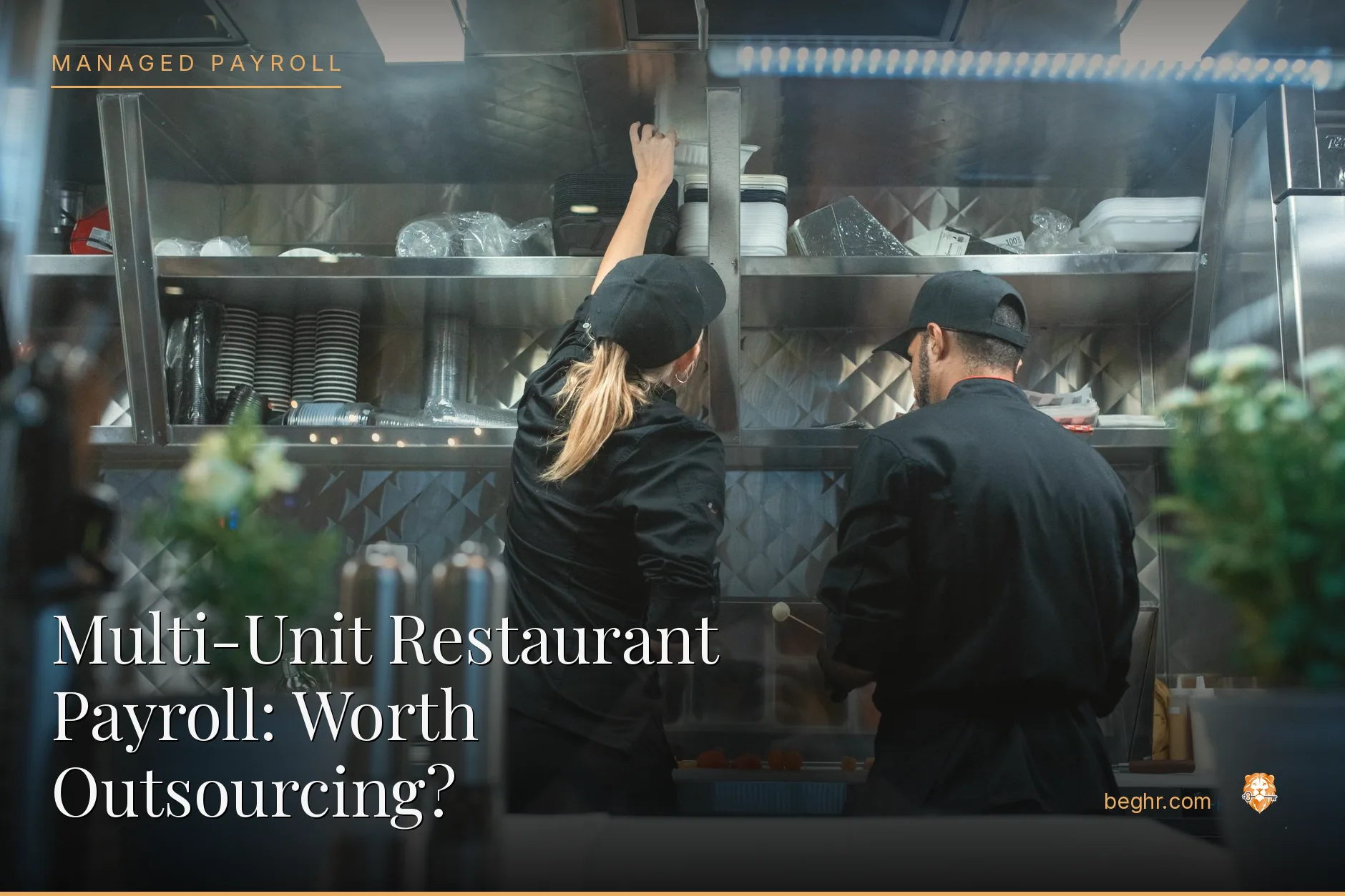
Running payroll for a single restaurant is manageable. Running payroll for five restaurants in three states, each with different minimum wages, different tip credit rules, and a combined workforce of 200 hourly employees with 150% annual turnover, is a full-time job. Multi-unit restaurant groups that manage payroll in-house past a certain scale end up with either an oversized HR/admin team relative to the operation, or an undersized team that is chronically behind on compliance. Outsourcing payroll to a managed service built for restaurant operations shifts that burden to people who do it for a living.
Why In-House Payroll Breaks Down at Scale
Single-location restaurant payroll has a complexity ceiling that multi-location operations blow past quickly. The inflection point is usually around 3 to 5 locations or when the group expands into a second state for the first time.
Common breakdowns at scale include: tip credit shortfalls going uncalculated because no one is monitoring the computation each pay period; minimum wage rate changes in one state being applied to another state by mistake or not applied at all; overtime calculations missing because an employee who worked shifts at two locations in the same week has hours counted separately rather than aggregated; and year-end W-2 production for 500+ annual W-2s being treated as a manual project rather than an automated output.
Each of these errors is a compliance liability. In aggregate, they add up to real money and real legal exposure.
What Multi-Unit Restaurant Groups Get from Outsourced Payroll
- Consolidated payroll processing: All locations under one service, one point of contact, one invoice. Location-level data is maintained within the system.
- State-specific compliance: Minimum wage rates, tip credit rules, daily overtime, and wage statement requirements are configured and updated per location market.
- Tip shortfall monitoring: Automatic calculation each pay period flags any location where tipped employees need make-up wages before payroll runs.
- Multi-location hour aggregation: Employees who work at more than one location have hours combined for overtime purposes, preventing overtime underpayment.
- Per-location reporting: Operators see their own labor data; group leadership sees everything; finance gets the consolidated P&L feed.
- High-volume W-2 production: Year-end W-2s for all employees including terminated staff, with W-2c corrections handled as needed.
- New location scalability: Adding a new location is a setup task, not a compliance crisis.
The Cost Math for Multi-Unit Restaurant Groups
| Group Profile | In-House Estimate | BEG Managed Payroll |
|---|---|---|
| 5 locations, 150 employees | $18,000-$30,000/year | $22,500-$40,500/year (full service) |
| 10 locations, 300 employees | $35,000-$55,000/year | $45,000-$81,000/year (full service) |
| 15 locations, 500 employees | $60,000-$90,000/year | $75,000-$135,000/year (full service) |
In-house estimates include burdened staff cost only; excludes software, compliance risk, and penalties. BEG estimates at $25-$45 PEPM.
What BEG Handles for Multi-Unit Restaurant Groups
- Consolidated payroll for all locations with per-location cost centers
- State-specific tip credit and minimum wage configuration by market
- Tip pool policy implementation compliant with state rules
- Multi-location hour aggregation for overtime accuracy
- High-volume W-2 and W-2c production
- POS integration for tip and hours data
- Accounting system integration for journal entry automation
- New location setup within 3 to 5 business days
- BEG Managed Payroll - fully managed at $25-$45 PEPM, all 50 states
One Service for Every Location
BEG manages multi-unit restaurant payroll from group compliance to per-location reporting at $25 to $45 per employee per month. Setup in 3 to 5 business days.
Frequently Asked Questions
How does BEG handle adding a new restaurant location to our existing payroll?
Adding a new location is straightforward with BEG. We set up the new location as a distinct cost center in the payroll system, configure the applicable state and local minimum wages, set up the tip credit configuration for that market, establish any new state employer registrations needed, and onboard the opening crew. If the new location is in a state where you already have existing employer registrations, the additional administrative burden is minimal. If it is a new state, we initiate registration immediately. Most new location additions are processing-ready within 3 to 5 business days of providing us with the location and opening crew data.
Can BEG integrate with our POS system for tip and hours data?
BEG supports integration with the major POS and restaurant management platforms used by multi-unit groups. The integration imports reported tip data and hours from your POS into the payroll system, eliminating manual re-entry of tip amounts and reducing the risk of data entry errors in tip reporting. The specific integration method varies by POS platform. During onboarding, we review your current POS and determine the most efficient data transfer approach for your setup.
We currently have three different payroll setups across our eight locations. Can we consolidate?
Yes, and consolidation is one of the primary reasons multi-unit restaurant groups transition to BEG. Multiple separate payroll setups create duplicate compliance obligations, inconsistent reporting across locations, and higher aggregate cost than a consolidated service. BEG manages the data migration from your existing processors, coordinates the cutover timing to avoid gaps in payroll processing, and establishes the consolidated structure with per-location reporting from the start. The transition process typically takes 2 to 4 weeks depending on how many existing systems need to be migrated.
What does payroll compliance management across multiple states actually cost when done in-house?
In-house multi-state payroll management for a restaurant group involves: dedicated staff time for payroll processing and compliance monitoring, subscription costs for a payroll software that supports multi-state, separate fees for multi-state tax filing support if your software does not handle it natively, and compliance penalty risk when rate changes or filing deadlines are missed. A 10-location restaurant group with 30 employees per location spending 15 hours per pay period on payroll at a burdened rate of $70 per hour spends roughly $1,050 per bi-weekly cycle on labor alone, or approximately $27,300 per year. At BEG rates, the same group pays $15,000 to $27,000 annually, fully managed.
How does BEG handle year-end W-2 production for a high-turnover restaurant group?
Year-end W-2 production for a multi-unit restaurant group with high turnover is one of the most labor-intensive tasks in restaurant HR. BEG manages the full W-2 production cycle: preparing W-2 forms for all employees who worked during the year (including terminated employees), processing corrections for address updates and data errors (W-2c forms), filing electronically with the Social Security Administration, and distributing W-2s to employees by the January 31 deadline. For groups with thousands of annual W-2s, BEG handles this at scale without additional per-form fees.
What happens if a location closes or we sell one of our restaurants?
When a location closes, we process the final payroll for that location's employees according to each applicable state's final pay timing requirements, close out the location's payroll cost center, and handle any required state notifications. If you are selling a location, the payroll treatment depends on whether the sale is structured as a stock sale (where the legal entity continues and payroll history transfers with it) or an asset sale (where the buyer creates a new employment relationship and separate payroll records begin). BEG coordinates with your accountant and the buyer's team on the payroll mechanics of a location sale or closure.
Also relevant: Managed Payroll for Multi-Unit Restaurants and Multi-Location Restaurant Payroll Guide 2026.
Authoritative source: U.S. Department of Labor: Wage and Hour Division
From the blog